


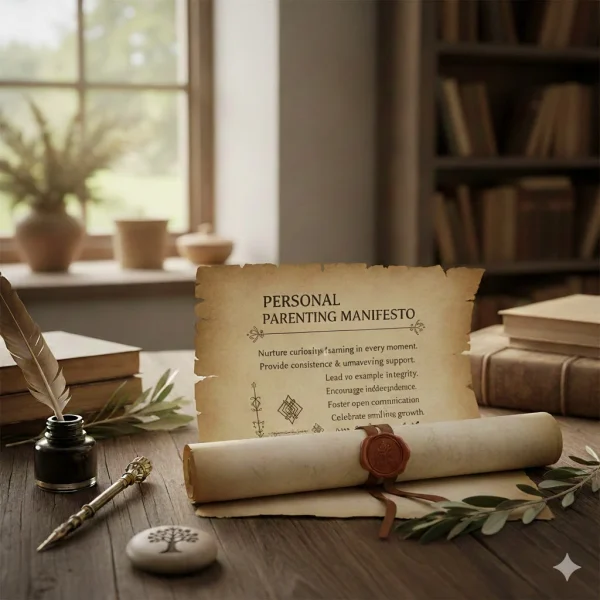
Roadmap from Instinctive Reactions to Conscious Choices
Most parents deeply love their children and embark on the parenting journey with benevolent intentions. However, a bitter reality lurks: many of us, in moments of pressure, fatigue, or a child’s stubbornness, exhibit behaviors that don’t align with our inner values. That famous phrase, “I didn’t mean to act that way, but it felt like I lost control,” is a shared experience among millions of parents.
This painful gap between “intention” and “behavior” isn’t due to your shortcomings; rather, it’s because of the human brain’s structure in facing stress. In this article, we’ll learn how to bridge this gap using a tool called the “Personal Parenting Manifesto” and regain control over our behaviors.
Why Do We Need a Parenting Manifesto? (Analyzing the Scientific Roots)
To understand why writing a few simple sentences on paper works wonders, let’s look at three scientific pillars:
- Neuroscience of Stress
In our brain, a part called the “amygdala” is responsible for detecting threats. When a child screams or defies our instructions, the amygdala— a key part of the human limbic system—identifies this as a “threat” and issues a fight-or-flight command. At that moment, the prefrontal cortex, responsible for logical thinking and self-restraint, essentially goes offline.
- Role of the Manifesto: The manifesto acts like a “shortcut circuit.” When your brain has already agreed on principles beforehand, it spends less time recovering logic during a crisis.
- The Power of Identity in Behavior Change
James Clear in his book “Atomic Habits” points out that the most effective way to change behavior is to focus on “who we want to be,” not “what we do.”
- When you say, “I try not to yell,” your focus is on the behavior itself (yelling).
- But when you write in your manifesto, “I am a secure parent,” you’re defining a new identity. The human mind strongly desires to align its behaviors with its identity (cognitive consistency principle).
- Attachment Theory and Co-Regulation
Contrary to popular belief, children aren’t born with the ability to self-soothe. They “borrow” calmness from the parent’s nervous system. If you as a parent don’t have a manifesto and framework for your own calmness, the child’s nervous system remains in turmoil. The parenting manifesto is actually the first step toward parental emotional regulation to become a safe haven for the child.
Step-by-Step Guide to Drafting Your Parenting Manifesto
Many parents get obsessive when writing their manifesto. Let’s break this process into 4 simple steps:
Step One: Identify Core Values
Ask yourself: “What qualities do I want my child to remember me by in adulthood?”
Words like: patient, attentive, firm, kind, or learner. Choose 3 key words.
Step Two: Turn Values into “I Am” Statements
Convert values into present-tense sentences.
- Instead of “I shouldn’t yell at my child,” write: “I am a parent who replaces the volume of their voice with the power of their words.”
Step Three: Write Short and Rhythmic
The manifesto shouldn’t be a long essay. Sentences should be such that in the height of anger, they repeat in your mind like a short mantra (e.g., “First secure connection, then behavior correction”).
Step Four: Accept Imperfections (Self-Compassion)
A professional manifesto must include a clause for times of error. For example: “I am a parent who has the courage to apologize and make amends when I make a mistake.”
Differentiating Levels of Manifesto Growth in the Valiyan Ecosystem
In the “Valiyan Educational Ecosystem,” we believe parenting is a path of gradual growth. That’s why your manifesto grows with you:
| Level | Target Audience | Main Focus | Expected Output |
| Level 1: Creation | Parents who have recently started the conscious parenting journey (members of the 21-Day Conscious Parenting Challenge) | Initial awareness and breaking the silence | A simple, heartfelt text of 8 to 12 sentences |
| Level 2: Stabilization | Parents who have passed the initial stages of the conscious parenting journey (members of the Valiyan Parenting Club) | Adaptation to everyday challenges | Revising the manifesto based on real weaknesses at home |
| Level 3: Development | Advanced and experienced parents | Integration with lifestyle | Turning the manifesto into a philosophy of living and self-care |
Common Mistakes in Writing a Parenting Manifesto
- Extreme Perfectionism: Parents try to write a manifesto that turns them into a holy, flawless being. Remember, the manifesto is written for a “human,” not a robot.
- Focus on Child’s Behavior: A manifesto that says “My child must be obedient” isn’t a parenting manifesto; it’s a list of expectations. The manifesto should only focus on your behavior.
- Heavy “Shoulds”: Using words like “should” is stressful. Instead, use phrases like “I strive to” or “I am a parent who…”
You Might Ask…
Should I Show the Manifesto to My Child?
If your child is old enough to understand the concept of a pact (usually over 6 years old), showing it or even posting it on the fridge can be very effective. This teaches the child that parents are also practicing and learning.
What If I Don’t Follow My Manifesto?
Breaking the manifesto is part of the process. The important thing is that after each failure, instead of self-blame, return to the manifesto and ask: “What prevented me from acting on this principle in that moment?” This is awareness.
How Long Does It Take to See the Effects of the Manifesto?
Small changes start from day one, but according to research, rewiring neural pathways in the brain requires about 66 days of repetition. The 21-Day Conscious Parenting Challenge is the initial steps of this path.
Final Words
The personal parenting manifesto isn’t a decorative piece of paper; it’s a living commitment. This manifesto reminds you that in the midst of parenting storms, you still have authority over your reactions.
Which Model Are You?
- If you’re currently going through the 21-Day Conscious Parenting Challenge, pick up a pen right now and write your first version of the manifesto in the comments section or your exercise notebook.
- If you’ve just discovered us, we suggest starting your amazing journey from instinctive parent to conscious parent today by registering for free in the 21-Day Conscious Parenting Challenge, alongside other parents with full support from a parenting coach.
Don’t forget: Excellent parenting doesn’t mean being flawless; it means continuous awareness.